Brooklyn Block Associations - Latest Updates
Audra Barrow at the HSVK Block Meeting, Feb. 16
Having had some dealings with Audra Barrow in which I found her to be an excellent estate lawyer, I was interested to hear her at the HSVK block meeting. For me she had shown an ability to grasp the facts of a case quickly and had then found a way to get a resolution equally quickly. She was the fourth lawyer I had turned to. The others complained about the complexity, it was not what they do, or they had never got back in touch after an initial interview. It turned out if one has knowledge combined with long successful experience, one can find a solution that gets to the heart of the matter. Having had a good personal experience, I was interested to hear what she would say in a general presentation about her field.
When I arrived at the venue at 243 Kingston Avenue, I found Ms. Barrow had set up a projector to present slides and was preparing her notes. The meeting quickly moved through some prelimnary house keeping, like passing around a sign up sheet and hearing some announcements, and then it was up to Audra. Here is some of what she said: It is important for everyone to have a plan of how to deal with the inevitability of old age and eventual death. It is not just for the wealthy or the elderly, and it is no good to decide not to dwell on “unpleasant thoughts.” Rather everyone has some wealth, everyone must face that they may not be able to make important decisions at some point, not just in old age, and thus everyone should have a plan to deal with what life gives them, both good and bad.
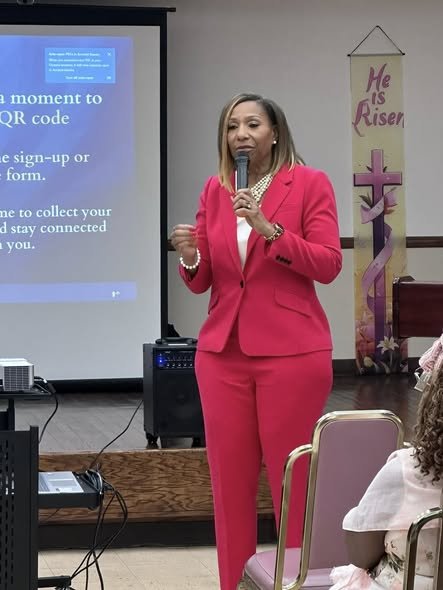
13.1 Ms. Barrow making a presentation
She began by saying there are laws that need to been taken into account and there are various options available. Starting with these, one can form a plan that suits one's situation. With no plan there are laws that come into play if one become incapacitated or dies intestate, meaning without a will. In both cases the state takes over and assumes control of one's estate. The state appoints a lawyer and guardian and they will make all the decisions about how to proceed and the people they choose will be paid from the estate. The lawyer will distribute money and property to next of kin and the guardian will decide about how to deal with one's health. One hopes these people will be competent and honest, but there is no assurance of that. Judges get their positions in Brooklyn through nominations of the Democratic Party, and sometimes there is a complicated set of obligations involved to serve politicians and lawyers that have nothing to do with how best to dispose of someone's estate.
So Audra's first point is to have one's own plan in place to avoid probate by the state. She mentioned five areas that need to be considered. These are: health care proxy, power of attorney, a living will, a will and some form of trust. With a health care proxy one appoints someone to make decisions concerning one's health. Does one want to be kept alive if one is unconscious with no chance of recovery? What if one is paralyzed and cannot speak? One can plan for one's decline and give someone authority through the proxy to make decisions that you can't, but they will know your wishes and will do their best to fulfill them. These you can created through a living will that will give guidance about what you do want and do not. So there will be a person you trust who has authority and knows your wishes. A power of attorney also comes in to effect in the same situation and gives a trusted person the ability to make financial decisions in your place. Surely better to appoint these people rather than have the state do it. There is also the necessity to make a will that reflects your wishes and it may make sense to create some form of trust. With these one might be able to avoid taxes and also avoid going to court. Trusts also need trustees to fulfill their intentions.
With a will, one's estate needs to be probated, that is, the will must be considered by the Surrogates Court who have the obligation to fulfill its terms. Relatives and others may go to court and challenge the will for various reasons, and this can tie the estate up while their claims are litigated. It is thus worthwhile to have what are called non-probated assets. One can do this by appointing beneficiaries. One can attach a name to a bank account or brokerage account that passes the holdings on to someone else. That person will not need to go to court. The same can be done with trusts.
One can create either a revocable or irrevocable trust. The first grants something to someone in the future, but can be altered. One might give something to a relative but then have a falling out with that person and change the terms of the trust. With an irrevocable trust this is not true. One has actually given something, and what one gives cannot be taken back. To be effective a trust must be funded and it must have a trustee or trustees. With both forms of trust one avoids probate and going to court. There is also the practive of giving gifts when one is alive. For example one might give real estate to one's offspring. There are dangers in this. The son or daughter is then financially responsible for the property and can determine much about its use. Getting insurance, renting, dealing with renters' complaints are all complicated. If the offspring goes bankrupt one can lose control of one's living space. Other complications can arise from divorce and remarriage and having a blended family.
So there are many different issues to be considered, but one thing is clear, one needs a plan and one needs to put it in place. At the end of her presentation, Ms. Barrow laid out three options. They were: option one,do nothing and have the state make all the decisions according to state laws. Option two, make a will and have the state probate that will. Option three, make your own plan that fits your desires and your individual situation. And finally, she emphasized that if you do have a plan review it regularly to reflect all the changes in your life. You may having a falling out with someone you thought would be a good guardian. You may give everything to your spouse, but death or divorce may force a change in that plan. Make a new plan!
At the end Ms. Barrow reviewed her schedule of fees. She was not there to solicit business but to give an idea what to expect if one wants a consultation and if that consultation leads to hiring a lawyer to form of a plan. There are other lawyers out there with their own schedule of fees. She wanted to give an idea of what to expect. She gives her presentation every two weeks on Wednesdays. One can get in touch to hear the presentation and then decide what comes next. One thing I came away with was the firm conviction that everyone needs a plan, and that plan should be made carefully considering all the options involved. Everyone lives in complicated mix of family and friends and organizations. As one moves through life one decides how to deal with all of these. There will come a time when one can no longer do that; however, one can still fulfill one's intentions if one takes care.
– John DeWind